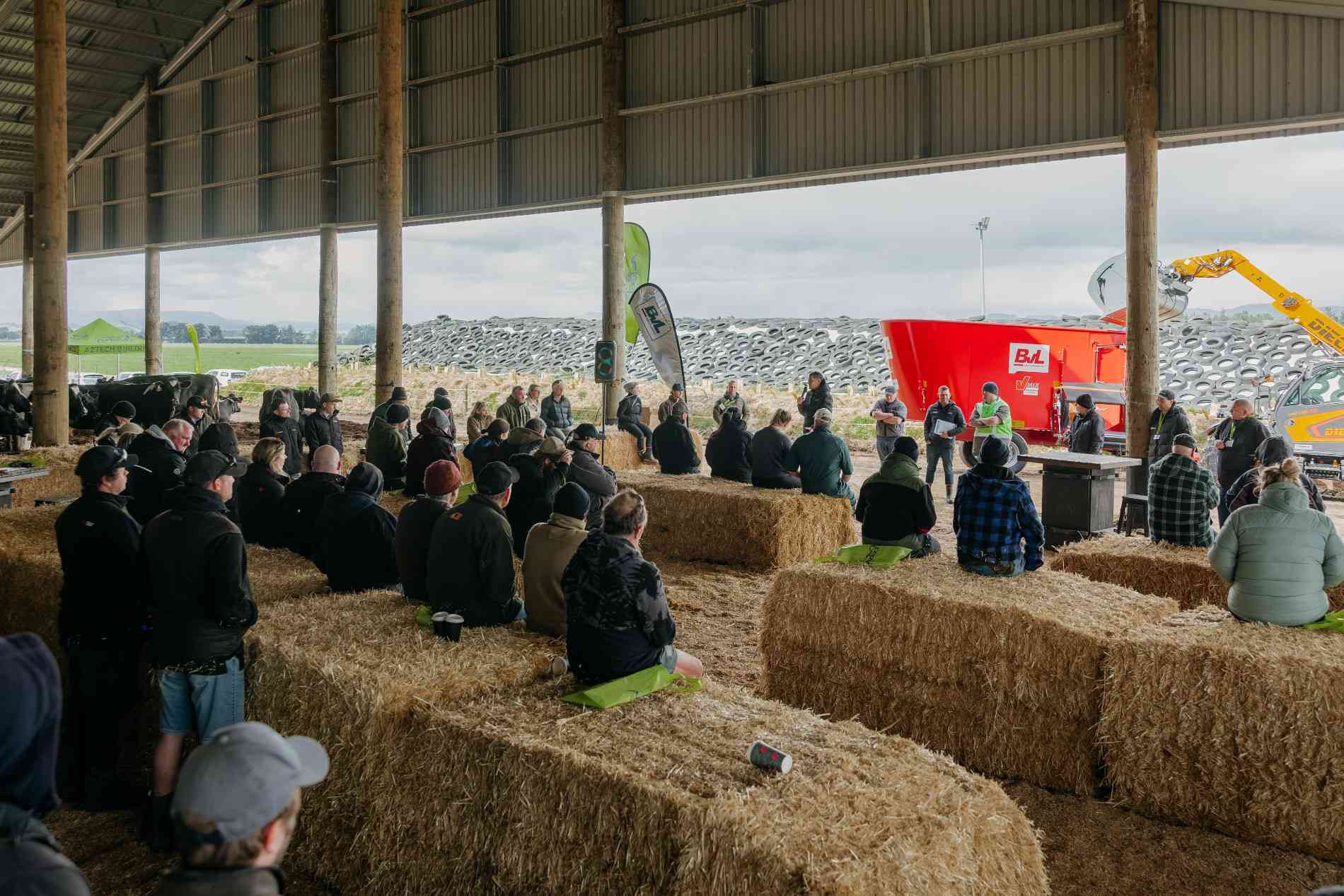
Composting barn roadshow at Waka Dairies in Dannevirke

Inside the Barn: Dannevirke Composting Barn Roadshow

23 September 2026 Waka Dairies, Dannevirke

We took our Composting Barn Roadshow to Dannevirke on 23 September 2026, the third of five stops, with our partners Schoof and Webline along for the day. Jono Buckley from Headlands Consultancy ran the programme.

Farmers and industry reps joined us at Waka Dairies, the Phillips family farm, to see a composting barn that has been running for about four years, watch the ripper go through the bedding and ask Michael Phillips and business manager Andrew “Bubbles” Evans how it works day to day.

Most of the day came down to management. Michael was clear that the barn opened up a lot of options on the farm, but it only pays off if the bedding is looked after. Here’s what four years of running it has taught them and what farmers asked.

The Dannevirke farm and why they built a composting barn

Composting Barn

Waka Dairies

Herd size 650
Barn dimension 90 m L x 60 m W
Style Gable
System Stratos

The Phillips family has farmed near Dannevirke since 1905, and Michael and his wife are about 18 months into a 10-year succession plan. The dairy platform is 230 effective hectares, with two runoff blocks nearby, and they grow most of their own feed, mainly maize and sugar beet.

Wintering used to mean cows on crop in the paddock. With the environmental footprint of winter grazing coming under more pressure, Michael decided to spend the money on housing instead of buying more land.

We decided to build some barns instead of buying some land.

Their first shelters were canvas-covered steel arches, and the poles gave way. They came down, and Michael had about nine months to rebuild on the same footprint with Aztech before the autumn-calving cows came in for winter.

The site and the build

Wind is the problem on this site, so Michael tailored the spec. He put the poles at 5 m spacing instead of 6 m, screwed down every rib of roofing iron, tightened the guttering brackets and upsized some of the perimeter poles. He also added pole savers, sealed sleeves that keep the timber out of direct contact with the bedding. Four years on, the barn has had no real issues, wind included.

When you do things twice, you can get it better the next time, which is what we’ve done.

The overhangs are 3 m instead of the usual 2 m, which keeps driving rain off the feed area and out of the bedding. Inside, bungee cords and chain powered from the poles split the barn into whatever pens are needed, and there’s a trough in every second bay, so a fenced-off mob always has water.

Four years in: how it runs now

Dry cows live in the barn and calve there. The springer mob comes through the shed, gets fed on the feedpad and goes back in, the same routine every day. In June and July the herd gets about 4 kg of pasture a cow, going out for an hour to an hour and a half in the morning and night, or nights only when it’s very wet. The longest they’ve kept late-lactation cows inside was 35 days, when it was too wet to eat grass.

I would much rather all those different challenges than where we had been, wintering outside on crops of beet or rape.

The barn is what lets them change how they farm. They moved from spring to autumn calving and, from April, will calve all year round, mating once a fortnight. Andrew says harvested pasture has gone from about 11 to about 16 tonnes a hectare, helped by new grass and no pugging, and wintering takes about 8 kg of feed a cow in the barn against 14 to 15 kg on crop.

Michael says nitrogen leaching has fallen from 70 to 80 down to about 25 to 30. It’s hard to separate the barn from everything else they changed, but they put it at about 30 to 40 kgMS more per cow.

What farmers asked about the Dannevirke composting barn

Most questions were about running the bedding day to day, plus what the rules mean for a new build.

Choosing fine wood chip

Michael has tried sawdust, coarse chip and fine chip. Sawdust composts quickly but burns through fast and costs more, while coarse chip holds its shape and doesn’t blow around. Fine chip is his middle ground, with some that breaks down quickly and some that lasts. The bedding is topped up before winter, and he expects the first full clean-out after about two years, with the used bedding going back on the maize and beet paddocks.

How Michael keeps the bedding working

Rip it as soon as the cows come off, so the steam and moisture can get out and oxygen can get in. Michael’s ripper takes half an hour to three-quarters of an hour, and he rips once or twice a day with the cows out, apart from springers in a fenced-off bay.

He’d be cautious about ripping more than twice a day, because it can let too much heat out of the pack. Feeding on the pad keeps moisture down. He tested temperature and dry matter early on, and now goes by feel, with a long probe pushed in deep to check.

What the regional rules say

Ian McNabb, a rural advisor with Horizons Regional Council, said composting barns are treated as wintering barns, so they sit outside the national stockholding area rules. In the Horizons region, the feedpad and effluent rules don’t apply either, because a composting barn isn’t mainly for feeding stock and doesn’t collect effluent beyond what’s in the bedding.

Harry Miller from Rural Consulting said that when a barn does trigger a consent, it’s usually at district level, over building height and floor area. Ian’s advice was not to build one just for the rules.

What Michael would change

Not much. He rebuilt once already and thought about turning the barn 90 degrees, but he’s happy with the layout. If he were feeding inside, he’d count the space per cow from the loafing area only, not the feeding area or a metre behind it. His bigger message for anyone starting out is that the first stretch is the hard part.

It is quite a complex system and it can seem a bit overwhelming, but once you get on top of it, we’ve found it to be relatively easy. But there are lots of challenges to solve before it comes easy.

Space, depth and airflow

Billy Gibbs, our regional sales manager, ran through the design points that matter most. We design for 8 to 12 square metres per cow. Eight is the minimum we know works, and where you land in that range depends on the diet and how you run the barn. Bedding should be at least 600 mm deep, and most of our barns run at around 700 mm of wood chip. Michael’s is a different system, with about 500 mm of fine chip.

The steep roof pitch and ridge vent draw air in from the sides and out the top, pulling moisture from the bedding. If airflow is compromised, the bedding can need pulling out every six to 12 months. Tilling once or twice a day while cows are in keeps it aerated. The rest of the checklist is in our composting barn guide.

Thank you to Michael, Andrew and the Waka Dairies team for hosting us, to everyone who came along, and to our partners Schoof and Webline, Headlands Consultancy, Rural Consulting and Ian McNabb. If there’s one thing to take from Dannevirke, it’s that a composting barn gives you options, but the daily look at the bedding is what keeps them working.

Thinking about a composting barn for your own farm? Talk to the Aztech Buildings team about your herd, your site and how you want the barn to work.

Frequently Asked Questions