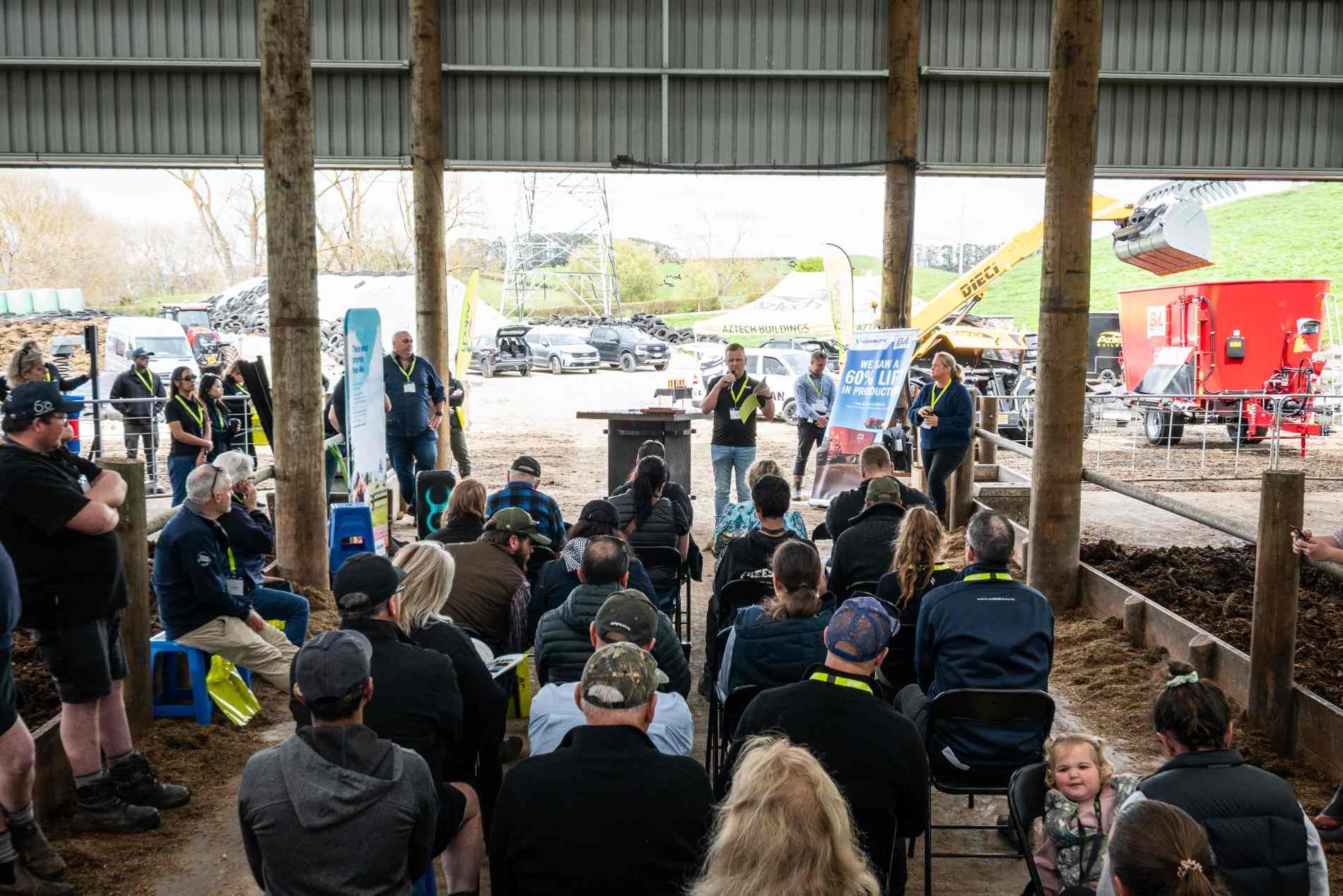
Aztech Waikato Composting Barn Roadshow

Inside the Barn: Waikato Composting Barn Roadshow

17 September 2026 Vos Farms, Huntly

We kicked off our Composting Barn Roadshow in Huntly, Waikato, on 17 September 2026, the first of five stops, with our trade partners Shoof and Huntech along for the day.

Farmers and industry reps joined us at Rene and Ereine Vos’ North Waikato dairy farm to see their working composting barn and ask how it runs.

Rene described the barn as a system change for the whole farm, not just a new building, and he was clear it isn’t the only reason for their results. Here’s how that played out, what didn’t go to plan and what farmers asked.

The Huntly farm and why they built a composting barn

Composting barn

Vos Farms

herd size 320 cows
barn dimension 45.5m W X 66m L
style Gable
System Futura Box-Beam

Rene and Ereine run a spring-calving herd on hill country in north Waikato. The hills grow grass right through winter, but in summer Rene says the ground is “like concrete”. He reckons the barn is bringing their production per hectare closer to their neighbours’, whose land is worth about twice as much.

Mud was what pushed them towards it. Wet spells meant dry cows were pugging paddocks, and that stressed Rene out most. Now, when rain is on the way, the cows come inside and stay until it clears, sometimes a week or two. Walking the paddocks today, Rene says there are no pugs anywhere and the pasture is dense. Protecting pasture was the starting point, but it ended up reaching calving, feeding and wintering too.

The site and the build

Siting came down to what was in the way. Power lines, a council drain and the boundary left one spot close to the cowshed. It’s also flood country, so the pad was built up to stop bank level. Rene joked that if the TV and sofa turn up in the barn, things haven’t gone well at home.

You don’t dig into the ground because you’re basically putting it in the water table. It’s got to be above the ground.

Dealing with the Transpower lines took about nine months. The green light came pre-winter, so they waited, started earthworks around Christmas and had the builders in during February’s dry spell. The clay pad had to be compacted and pass a test, a bit like a pond seal test.

The bedding is 700 mm of woodchip over a clay base, with an overflow running through each bay to the far corner. They didn’t have to do that by law but wanted to show the council nothing was leaching, and nothing has come out. The layout is a centre feed lane with a bay on each side, which Rene says works like two feed pads, with springers on one side and milkers on the other.

The first year: what didn’t go to plan

Rene was open about the bumps, and two things stood out. Both show how the building, the bedding and the way cows are fed all affect each other.

The first chip load was fairly small and ripped well. A later load had bigger pieces, and he didn’t realise how good the first had been until he tried the second, which didn’t flow or cultivate as nicely. He’s since mixed the smaller chips back in and says about 100 mm is the biggest he’d want.

The second was diet. A wet summer crop and not much dry feed going into the barn made the bedding messier over summer.

We’ve learned that you need a drier diet. You can’t go and feed a very wet summer crop on a very good growing summer year with lots of grass and come in here

Rene wouldn’t grow another brassica crop for this system. He also pointed out it’s been a mild winter, so the barn hasn’t yet faced a really wet one.

What farmers asked about the Huntly composting barn

Almost every question came back to the same thing: the barn is one part of a bigger system. Here’s what farmers wanted to know.

Calving in the barn

Calving went from the best part of an hour to about 15 minutes. Before the barn, it meant chasing cows and calves around a paddock over the hill on the four-wheeler. Now Rene drives a trailer through, picks up the calves and half the mums follow. Springers sit on one side and the colostrum cows come in at night, so one check covers both.

Calves have been healthy, and the only navel ill cases were born out in the paddock. The barn also made a two-week transition diet possible, which Rene says doesn’t work when you’re feeding out in the mud.

Feed

Dry cows wintering in the barn need about 7 to 8 kg of feed, compared with trying to get 12 kg of grass into them at pasture. Rene says they stand or sit chewing their cud rather than hanging around the gate.

Production and mating

Rene shared the numbers behind our Vos Farms one-year-on story. He recorded about 45,000 kgMS more than the year before, around 130 kgMS per cow, and the six-week in-calf rate lifted from 67% to 75%. This season the herd peaked at about 2.5 kgMS per cow per day, up from around 2.1.

He was careful about what that proves. They also spent more on feed, and last year was a good growing season.

Bedding upkeep

Ripping takes about 15 minutes a day. The first year’s clean-out was the feed face, where cows stand and the pack gets dirty. It took half a day with a digger and two muck spreaders; about $20,000 worth of chip went back in, and the old material went onto the maize ground. He chose that over a concrete feedpad, which would mean scraping and storing effluent.

Cow health

The vet had warned Rene to watch for mastitis, but he hasn’t seen it, and cell counts have stayed reasonably consistent. The staff say the cows are content and milking consistently from start to finish.

Would they do it again?

Rene says yes, and he’d change very little, maybe adding another bay. He thinks it suits wetter farms best.

Do your homework. Make sure you know what kind of system you want to run. Make sure you’ve got the people on board who are going to be running it.

Why the design is what makes the system work

Aztech sales manager Joseph Hoyle used the barn to show farmers how design decides whether the system holds up. Get it right and the bedding keeps working. Get it wrong and you pay for it.

If you cut corners in the barn design, you’re going to pay the price year on year because you’re going to be replacing your wood chip a lot more.

The basics start with space and bedding. Joseph said Aztech designs for about 8 square metres per cow, with at least 600 mm of bedding, tilled once a day. Rather than pulling bedding out, he suggested topping up about 80 mm a year, and he advises against sawdust because it breaks down quickly. Those are among the seven design points in our free composting barn guide, which was in everyone’s bag on the day.

Airflow does the rest. Joseph called the 18-degree roof pitch “absolutely essential”, because warm, moist air rises and leaves through the ridge vent. On a flatter roof or in a tunnel house, that air has nowhere to go. It forms condensation and drips back onto the bedding, which pushes cell counts up and means replacing the bedding every year. The steam coming off the Vos bedding on cold mornings, when it’s tilled, is that moisture on its way out.

He added that a barn like this typically runs 8 to 10 degrees cooler inside than outside, which helps hold milk production on a hot afternoon.

Thank you to Rene and Ereine for opening up their barn, to everyone who came along with questions, and to our trade partners Shoof and Huntech. If there’s one thing to take from Huntly, it’s that a composting barn is a system, not just a building, so know what you want that system to do before you build.


Wondering how a composting barn would fit into your own farming system? Talk to the Aztech Buildings team about your farm, herd and what you want to achieve. 

Frequently Asked Questions