


.svg)
.svg)
Composting Barns NZ: Bedding, Feed Efficiency & Farm System ROI
Composting barns have moved from being a relatively new idea in New Zealand dairy to a serious infrastructure conversation for farmers looking at wintering, animal welfare, environmental pressure and long-term farm resilience.
That was clear at the Wintering in Canterbury: Infrastructure & Forage Crops event held at Hotel Ashburton on 1 July 2026, where farmers, researchers, irrigation groups and industry specialists came together to talk through what is working, what still needs more research, and where the real value is being created on farm.
The session brought together Dr Keith Woodford from Agrifood Systems, who spoke on composting barns, and Dr Brendon Malcolm from the Bioeconomy Science Institute, who co-presented with Shane Maley on nitrogen management in winter forage crops. The farmer panel, featuring Matt Iremonger, Dave McLeod and Rob Mawle, added the practical on-farm experience that made the afternoon especially valuable.
A big thanks to MHV Water, ALIL, Acton Farmers Irrigation Cooperative, Rangitata South Irrigation, BCI and Enviro Collective for putting the day together.
For Aztech, the biggest takeaway was this: a composting barn is not just a building decision. The return comes from how well the structure, bedding, feeding system, ventilation, cow flow and wider farm management all work together.
TABLE OF CONTENTS:
Bedding Management
One of the strongest themes from the day was bedding management, particularly when bedding should be replaced.
Fresh bedding can start with a carbon-to-nitrogen ratio of around 100:1, sometimes higher. The general recommendation is to replace bedding once that ratio drops to around 15:1. In practice, we are seeing a lot of farmers remove bedding earlier, often around 20:1 to 30:1.
That can mean farmers are removing bedding while it still has a large amount of useful life left in it.
The practical advice from the day was simple but important: buy bedding on a tonnage basis, not volume, and know the dry matter content of what you are buying. Relying on volume alone can make it hard to understand what you are actually paying for and how long that bedding should perform.
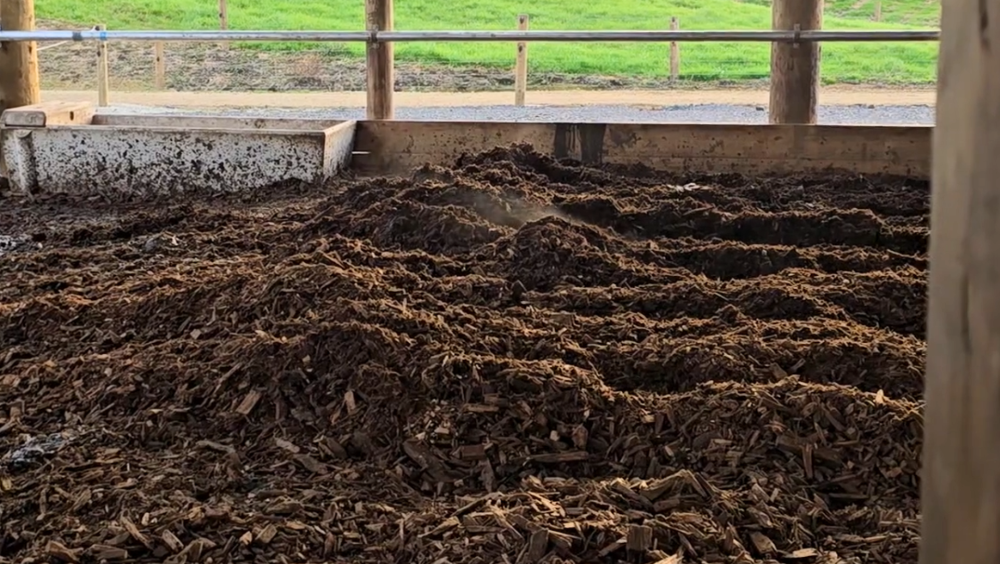
On bedding material, there are different views across the industry. Dr Keith Woodford’s preference is sawdust. At Aztech, we tend to favour wood chip in many systems, but the right answer can depend on availability, price, freight, moisture content and how the barn is being managed.
One farmer at the event also raised a practical issue with wood chip getting caught in cows’ hooves. That is a fair consideration and exactly the sort of detail farmers need to weigh up when planning a system.
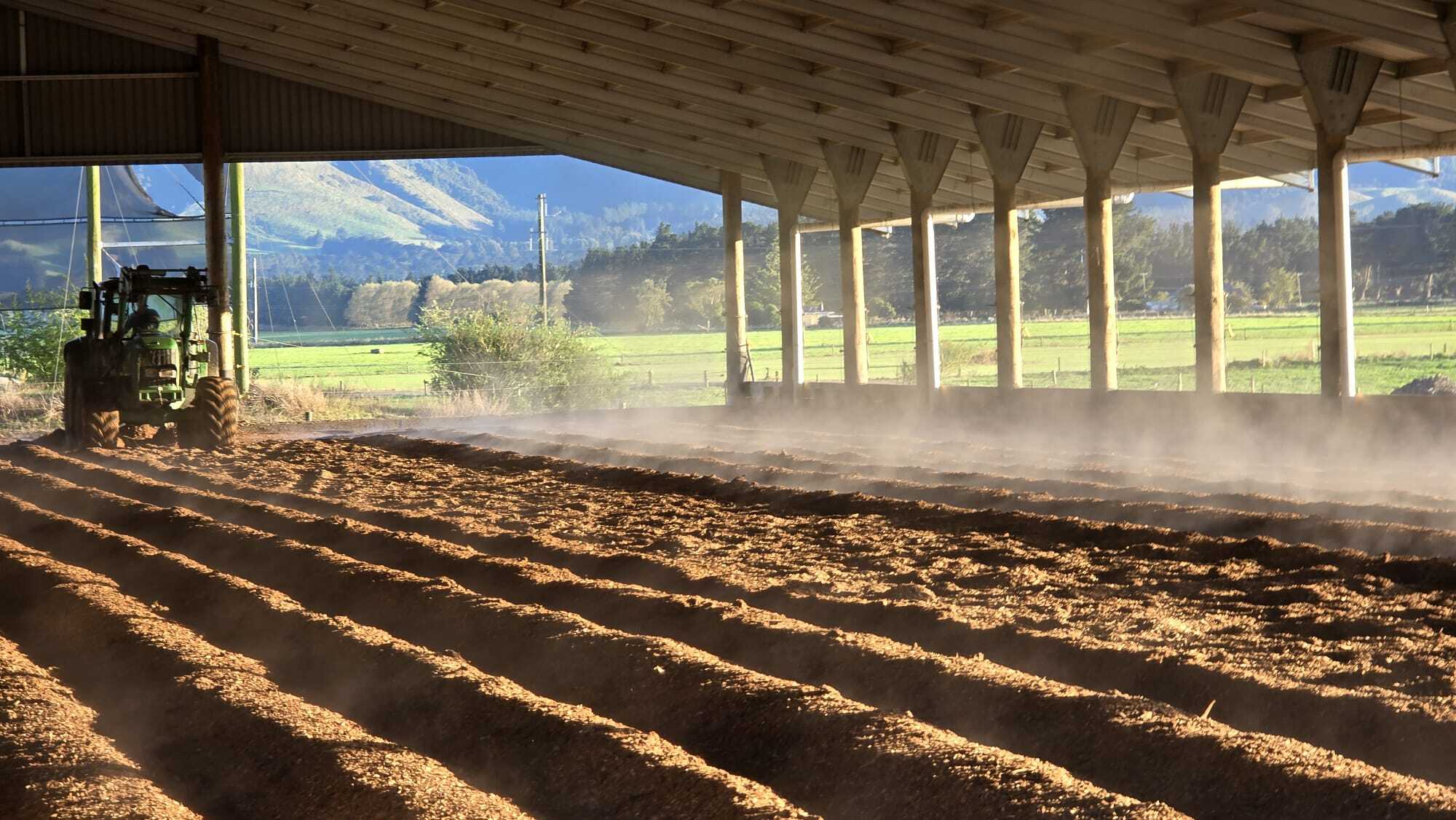
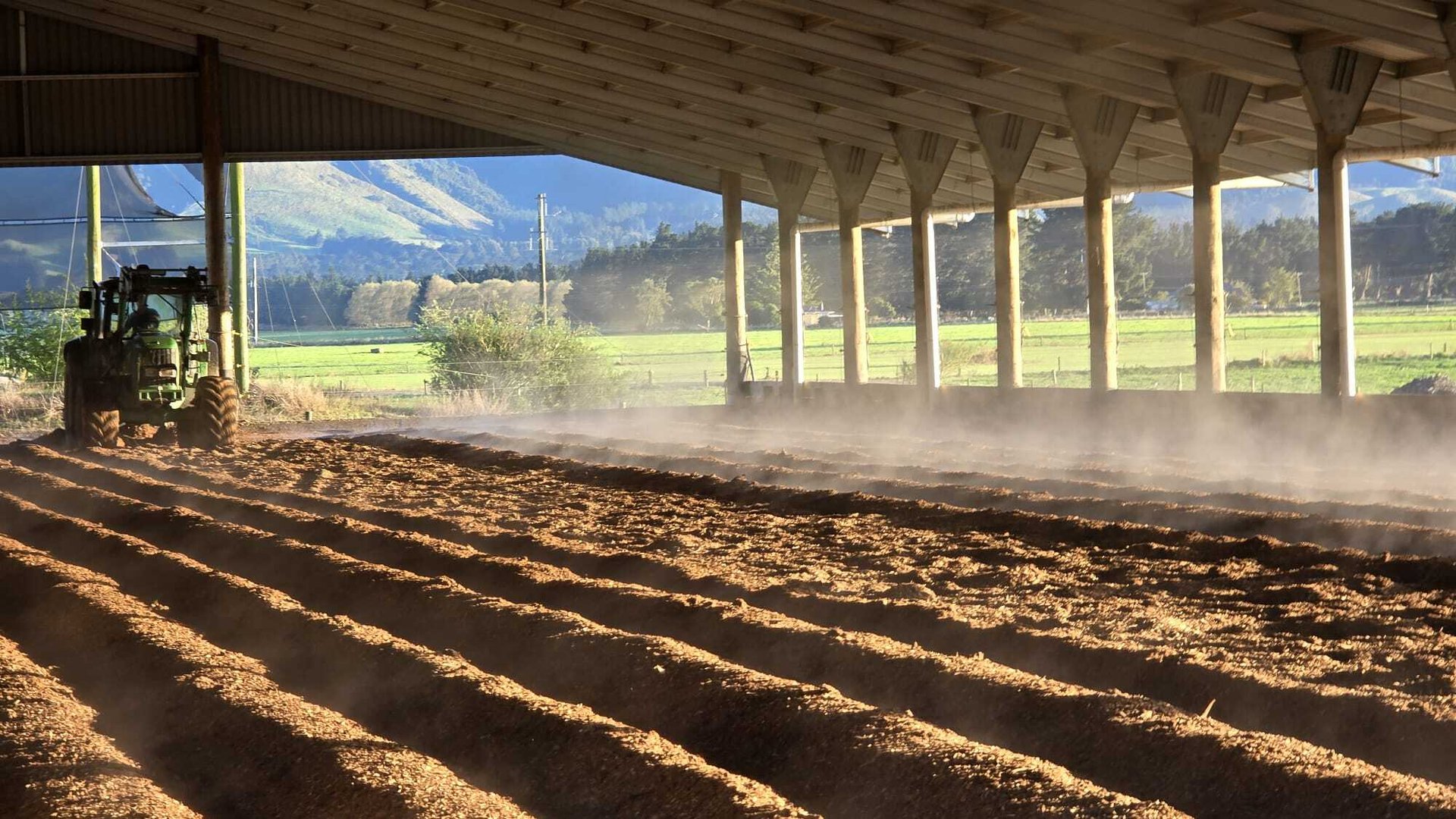
Waka Dairies Composting Barn, Early Morning Tiling
When the bedding pack underperforms, experience matters
One of the more memorable examples shared on the day involved Tony Allcock’s farm, often referred to as the “Mootel”.
The compost bedding pack had dropped to around 30°C and was not performing as it should. Dr Keith Woodford arranged a truckload of miscanthus, and within ten days the compost temperature had climbed to around 60°C.
It was a good example of how bedding biology, carbon sources and management decisions all interact. When the composting process is underperforming, the answer is not always structural. Sometimes it comes back to the bedding material, moisture, carbon, temperature and how the system is being worked day to day.
Tony’s barn is also an Aztech build, first planned with him around 14 years ago. For us, that history matters. We have been involved in composting barn projects since well before they became a mainstream infrastructure option, and that experience becomes especially important when a barn needs more than a standard design answer.
Across the barns we have designed and supplied over the years, the biggest lesson is that successful composting barns are rarely about one feature. They come down to the full system: structure, airflow, bedding, feed access, drainage, cow behaviour and the way the farm team manages it.
Miscanthus is clearly effective in the right situation, but it is not a cheap or casual option. At around 100kg per cubic metre, freight can become a major cost if it is not sourced locally.
Feed efficiency is one of the clearest financial drivers
Feed efficiency continues to be one of the strongest arguments for well-designed off-paddock infrastructure.
With an off-paddock feed-out system, feed conversion efficiency can reach more than 98%. Some barns are seeing around 8kg of dry matter per cow per day in winter, compared with a typical allocation of 14 to 18kg without a barn.
That is a significant reduction in feed demand, and for many farmers, it is where the economics of the barn begin to make sense.
But the setup needs to suit the farm.
Some farms feed inside the barn. Others feed outside the barn while still using the composting area for standing, shelter and resting. Waka Dairies in Dannevirke, run by Michael Phillips, is one example of an Aztech barn designed around an external feed-out model.
That is an important point. A composting barn should not force every farmer into the same operating model. The design needs to support the way the farm works, the herd size, the wintering strategy, the feed system, the effluent plan and the long-term goals of the business.
In Canterbury, semi-stabilised shingle bases are commonly used, with cows recommended to stand on compost while feeding. Once concrete is introduced into the barn floor, effluent management becomes a much bigger consideration. That is one of the clearer arguments for keeping the internal area as a compost-only floor where the system allows.
On animal health, the message from the day was clear. Done properly, there is no reason a composting barn should create animal health issues. As with any farm system, design and management need to work together.
The barn has to change the system around it
One of the strongest cautions shared on the day was that a barn is not a fix on its own.
If the wider farm system does not change around the infrastructure, farmers may not see the full return. That could mean adjusting wintering strategy, feed planning, once-a-day milking, lactation length, pasture management, cow flow or labour allocation.
The barn creates the opportunity, but the system has to capture the value.
Other results shared on the day reinforced that point. One farmer expects five to six years of usable life from wood chip bedding sourced from trees felled in a storm, turning what was essentially a free input into a multi-year asset. Others spoke about consistent reductions in feed cost, more pasture harvested overall and the benefit of eliminating pugging during wet periods.
Where the industry needs to go next?
The clear ask from the room was for a better documented research programme around composting barns in New Zealand.
Farmers are already doing valuable things on farm. They are learning what works, what does not, what needs adjusting and where the strongest returns are coming from. The opportunity now is to capture that knowledge properly and turn it into a resource the wider industry can use.
That is a gap Aztech is well placed to help close.
We have designed and supplied composting barns across different regions, herd sizes, climates and operating models. We have farmer relationships that go beyond the build itself, and we continue to see how these systems perform once they are in use.
For farmers considering a composting barn, our advice is simple: visit working barns, talk to farmers who are already using them, ask hard questions, and make sure the design is built around your farm system, not someone else’s.
A composting barn is a significant investment. Done well, it can improve cow comfort, reduce pressure on pasture, support environmental outcomes and create a more resilient farming system.
But the real return does not come from the roof alone.
It comes from the full system underneath it.
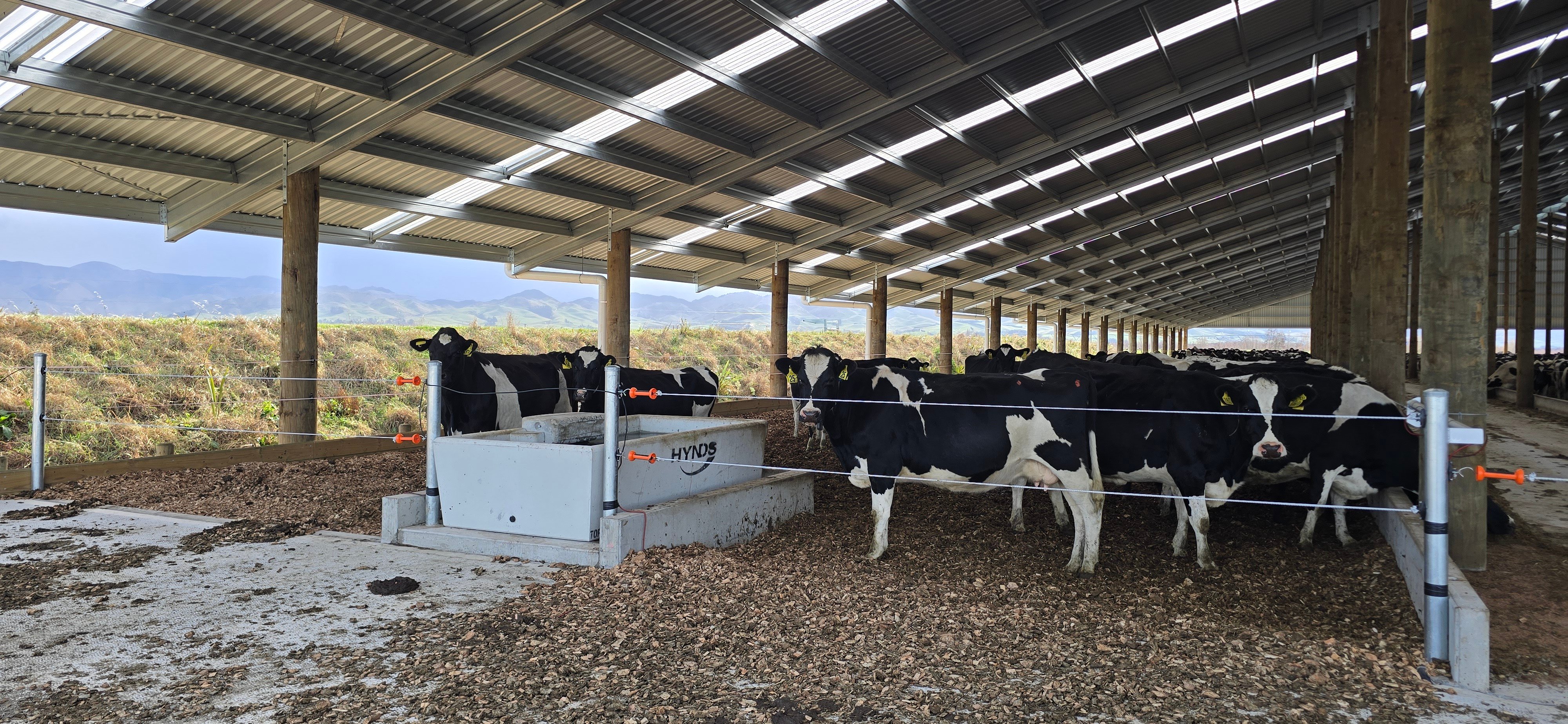
John Faulkner Composting Barn, Culverden, Canterbury
Quick Links:
Learn More about Aztech Composting Barns
Learn More about Aztech Feedpad Covers