


.svg)
.svg)
- Home
- /
- Events
- /
- Invercargill Composting Barn Roadshow
Inside the Barn: Invercargill Composting Barn Roadshow
30 September 2026 Carl North
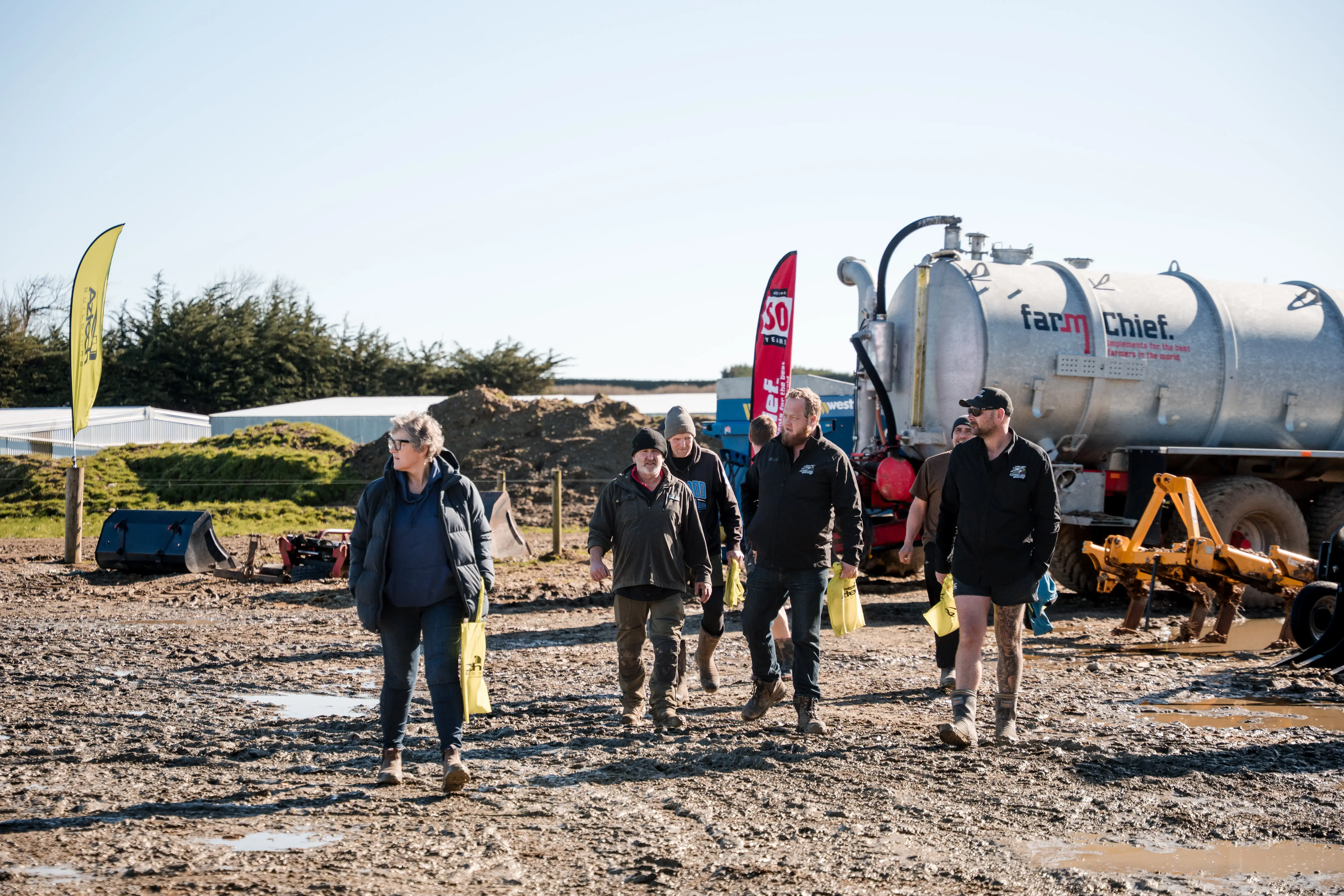
The final stop on the Aztech Buildings Composting Barn Roadshow took us to Invercargill on 30 September 2026, with sponsor partners Farm Chief, Shoof and DeLaval along for the day. Farmers stepped inside a working composting barn on a Southland dairy farm, heard from the people who built it, then spent the rest of the day putting their questions to them.
Carl and Rachel built theirs to protect pasture in very wet conditions, take pressure off calving and get more from their feed. Here's their story and what farmers asked.
The Southland farm and why they built a composting barn
Composting barn
Carl North
Carl and Rachel have farmed the property for around 25 years. It's 150 hectares, milking about 420 cows, with production around 500 to 520 kgMS per cow last season. Before the barn they wintered and calved at a runoff, with calves and heifers grazed off the farm. That meant a lot of carting stock back and forth, long days and a harder time feeding freshly calved cows.
The farm is also very wet, with pockets of clay that hold water. Two years ago a wet spring meant an expensive regrass of around a third of it. Carl started looking at off-paddock options about six years ago and wasn't keen on concrete floors, because stock on concrete seemed more flighty. He chose Aztech for the science behind the design, which is built around airflow and composting rather than just putting a roof over cows.
The site and the build
The North composting barn sits on a ridge between the cow shed and the effluent pond, so water drains away both ways and the footprint stays compact.
The pad was scraped back to bare clay and ready for the builders on 1 December. Carl said keeping outside water out was a bigger issue than anything getting out, so the drainage went behind the walls rather than under the bed. He chose concrete walls for durability, easy scraping and resale value. Consenting went smoothly with Rural Consulting handling it, and the farm got a refund on its consent deposit from Environment Southland.
The build moved quickly and smoothly. Aztech's kit arrived on farm when it was supposed to, and the crew on site was usually just two people, rising to five or six on a couple of days. Carl originally planned to do a lot of the concrete himself, then brought in a concrete crew at the end of May, who poured 750 square metres in a single day.
The woodchip came from a local contractor who chipped logs straight into trailers and tipped them into the barn. The farm milked through to 29 June while the final concrete went in, and the cows moved in the day after the last slab was poured.
The first season: feed and calving
Feed has been an early win. Carl and Rachel planned on simple feeding, then realised a mixer wagon would let them manage fibre, minerals and transition feed properly. Offered feed dropped from about 10 kg to about 6 kg per cow over roughly a week while cows held body weight.
Calving has changed too. About 100 cows calved in the barn this season, calves are clean and dry, mothers move easily into the neighbouring colostrum group, and they reported no milk fever.
What farmers asked about the Invercargill composting barn
Once the farm conversation wrapped up, the floor opened and the questions came thick and fast.
What the Invercargill composting barn cost
Cost was the first thing on people’s minds. Carl said the whole project came to around $2 million, but that covers the full development, not just the barn: the barn itself, concrete, siteworks, the silage bunker and woodchip, plus the work around the site. That figure is specific to this farm, so it isn’t a standard composting barn price, and what you spend will depend on your site, your herd and what else needs upgrading at the same time. The bigger surprise was price movement. Concrete was quoted at $275 a cubic metre and one bill came in at $330, and steel cost more than expected too.
How much woodchip went into the barn
From there the conversation moved to woodchip. The barn holds around 2,400 cubic metres. Carl and Rachel planned on about 500 mm with a top-up of roughly 100 mm before calving, but the fresh chip compacted more than expected, so about 300 mm went in instead. They're aiming for around three years from this first pack, and one adviser in the room said some of their clients are seven years into running a barn.
Looking after the bedding over summer
Bedding care drew plenty of curiosity, especially what happens once the weather warms up. The plan is to rest the bedding and keep aerating it so it doesn't turn into a brick, ready for autumn, Carl said. The feed lane is the wettest and most compacted area, so it gets extra attention. Then it was out to the ripper, which pulls material up from near the bottom of the pack while a second cultivation works higher up. It took about four passes for the bay demonstrated.
Return on investment so far
Then came the big one: is it paying off yet? It's too early to say. Carl was upfront that the return is probably negligible after only six weeks of milking, though they're targeting about 20,000 extra kilograms of milksolids. An adviser added that the modelling they've seen points to around 1.5 tonnes of extra pasture harvest on a farm growing about 11 tonnes, most of it before Christmas. And what would the farm look like without the barn? Carl's answer was one word: "carnage."
Feed compared with the runoff
Feed was next, and how it stacks up against the runoff, where they were offering around 12 kg of baleage. Stacked silage means less wastage, better quality and far higher utilisation, Carl said.
How quickly a Southland composting barn can go up
Some people wondered how fast a barn can go up. Quicker than you might think, the team said, as long as the design work is done upfront. They pointed to a Taranaki barn that was started at the end of May and had cows in by the end of July or the start of August.
What Carl and Rachel would do differently
The day closed with the question every farmer wants answered. For Carl and Rachel, it comes down to time. Because of the tight timeline, cows moved in almost straight away and the pack ended up wetter than ideal. Their other advice was simple: have good people around you.
Design and consent advice from the day
Carl and Rachel weren't the only ones fielding questions. Farmers also heard from Aztech and Rural Consulting on the day.
Aztech walked everyone through the design features they could see around them. The roof has an 18-degree pitch and a ridge vent to keep air moving through the barn. The 2.5 m overhangs and a 3 m concrete strip across the gable ends keep rain out of the bedding. The fully enclosed Futura steel box-beam roof leaves no cavities for birds. The full list of design points is on our composting barns page and in our free composting barn guide.
Rural Consulting then covered the consent side. Regional and national rules are very permissive for these structures, and district rules mainly look at building size, height and earthworks. To get started, they just need to know what you want to build, how big it will be and where it will sit on the farm. They also offer a free initial planning assessment for all Aztech builds.
That's a wrap on the Composting Barn Roadshow, with Invercargill as our final stop. Thank you to Carl and Rachel for hosting, to everyone who came along with questions, and to our sponsor partners Farm Chief, Shoof and DeLaval.