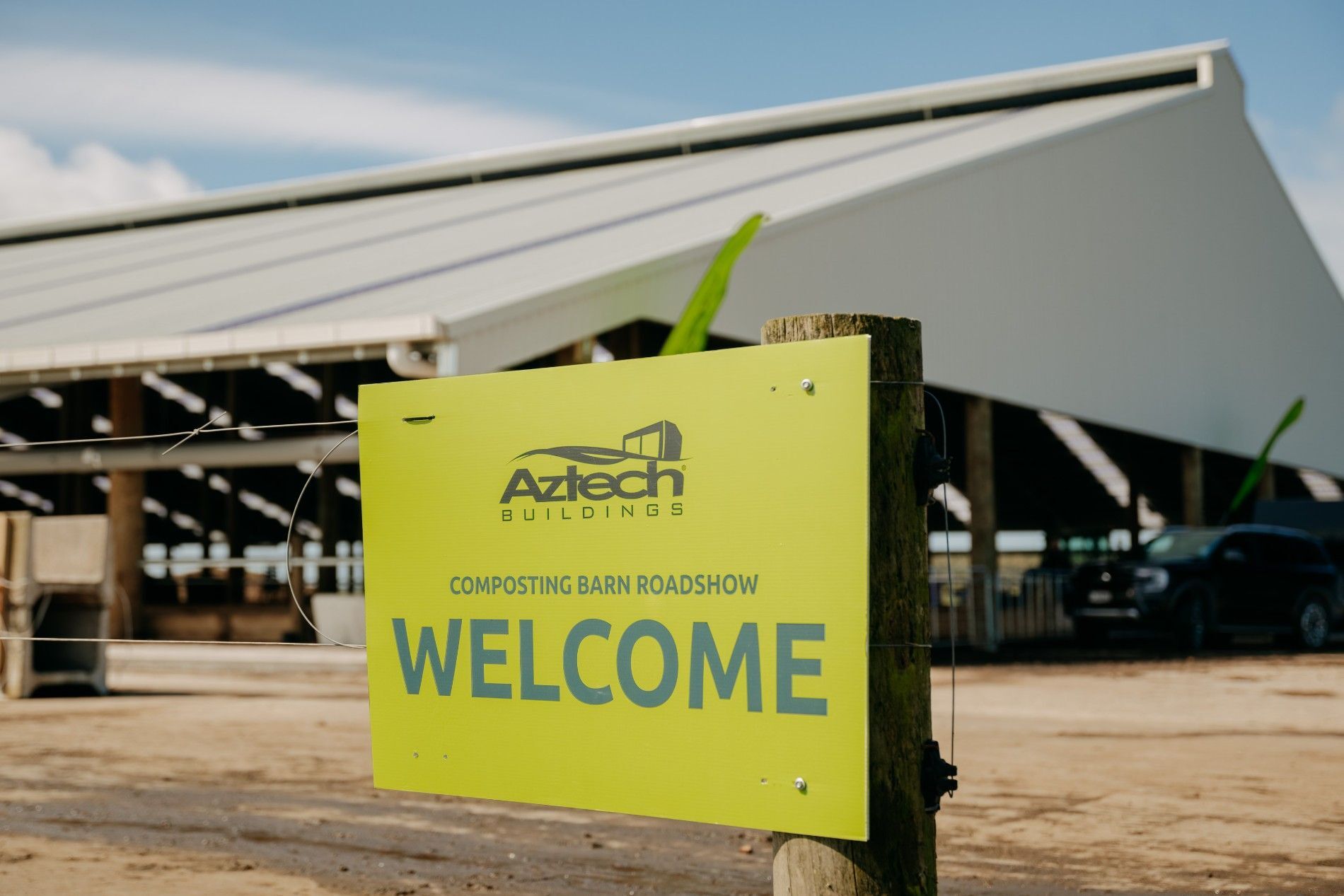
Inside the Barn: Taranaki Composting Barn Roadshow
22 September 2026 Clayton-Greene Farm, Awatuna
We took our Composting Barn Roadshow to Taranaki on 22 September 2026, the second of five stops, with our partners DeLaval, Schoof and Webline along for the day. Jono Buckley from Headlands Consultancy ran the programme.
Farmers and industry reps joined us at Campbell Clayton-Greene’s dairy farm to see his new composting barn, watch the ripper run through the chip and ask how he plans to run it.
This was a brand-new barn, with cows in for only a month, so the day was about the plan more than the results. Campbell was clear that for him the barn is a tool for growing and using more grass, not a place for the whole herd. Here’s why he built it, what he expects to see and what farmers asked.
The Taranaki farm and why they built a composting barn
Composting Barn
Clayton-Greene Farm
Campbell and his wife are now in their fourth season on the farm, and he suspected wintering would be the challenge. Wet spells meant pugging, and with nowhere to hold springers and dry cows off the pasture, they were making a lot of mess. He looked at a standoff pad, covered pads and rubber matting before landing on a hard-top structure that would last.
The site and the build
The barn is built to the slope of the land, with about a two-metre fall along its length, which kept earthworks down. Under the bedding is clay with no drainage, plus overflow pipes at both ends that run out to a manhole so Campbell can check for leaching. A month in, nothing has shown up.
The ground was the tough part. They’re on the side of a volcano, so drilling the pole holes through stone was harder than expected. Campbell and his mates did the internal fit-out once the builders had the structure up. Cows went in a month before the event.
The chip is kiln-dried mill offcuts put through a grinder and a 100 mm grader, about 2,400 to 2,500 cubic metres. Campbell had seen Rene Vos’ barn near Huntly, where we held our Waikato stop, and liked the bigger chip used there.
The first month: what he’s watching
Campbell’s staff have one word for calving in the barn.
The barn is still in the early days. There’s a little steam off the bedding, but nothing like full composting yet, which he expects once about 200 cows have been through. When 400 cows went in on one wet night, the team moved them straight in. Ripping takes about half an hour, and he plans a quick hitch so the tractor can swap between the ripper and the feed wagon. He’s still working out how to look after the bedding when the barn is empty.
Cow health is one to watch, but early signs are fine. There’s no chip between the cows’ toes so far, though few cows have been through, and one downer cow got up easily. Feed is palm kernel, grass silage and a bit of hay, with minerals layered through it. Cold and westerly wind came up in the Q&A, so a windbreak is planned, and conduits are already in for cameras to watch the springing cows.
What farmers asked about the Taranaki composting barn
Questions ranged from what Campbell expects to get out of the barn to whether the whole herd needs one.
What does he expect to get out of it?
Pasture is the main prize. Campbell is budgeting on about 0.5 to 0.6 tonnes more dry matter per hectare, which he reckons could be worth roughly 20,000 kgMS across the farm if it goes well. A back-of-the-envelope budget and a Farmax check from AgFirst came out with a similar return. He was upfront that it all depends on turning the extra grass into milk.

Does the whole herd go in?
No. The barn holds about 400 of his roughly 770 cows. Taranaki grows a little grass in winter, so cows go out when the paddocks are good, and he’d dry off at covers of about 2,000 rather than 2,400. He doesn’t see the value in housing the whole herd and isn’t planning to put young stock in.
Feed and cow health
Cows are on palm kernel and grass silage with a bit of hay, and the team layers minerals through the feed. Campbell reckons next spring will be the real test of that.
Consents
Campbell found consenting straightforward. Harry Miller from Rural Consulting said Taranaki’s planning rules are favourable, and the usual issues are the size of the building, setbacks and height. He recommended building in a way to collect anything that leaves the bottom of the bedding, because rules can change.
What would Campbell change?
He wanted cows in and earning, so he pushed to finish, and the drilling made it harder than it needed to be. If he did it again, he’d start now and take the time to have it ready for next May.
How the barn is built to work
Billy Gibbs, our regional sales manager, took farmers through the seven design points we’ve found make or break a composting barn. We design for about 8 square metres per cow and at least 600 mm of bedding, typically 700, which gives farmers five to seven years out of their chip when it’s managed well. Campbell’s has compacted to about 550 to 600 mm, so he expects to top it up.
For a barn that’s empty, Billy said to rip once or twice a week, then daily once cows are in. The 18-degree roof pitch draws fresh air in from the sides and up through the ridge vent, and there’s one clear light per bay, enough to charge cow collars. If you want the full list to check against your own plans, the composting barn guide covers all seven.
Thank you to Campbell and his team for opening up a barn that’s only a month old, to everyone who came along, and to our partners DeLaval, Schoof, Webline, Headlands Consultancy and Rural Consulting. If there’s one thing to take from Taranaki, it’s that a composting barn is a tool in a grass system, so know what you want it to do before you build.